Nearshoring vs Offshoring in Fashion: Which Sourcing Model Is Right for Your Brand?
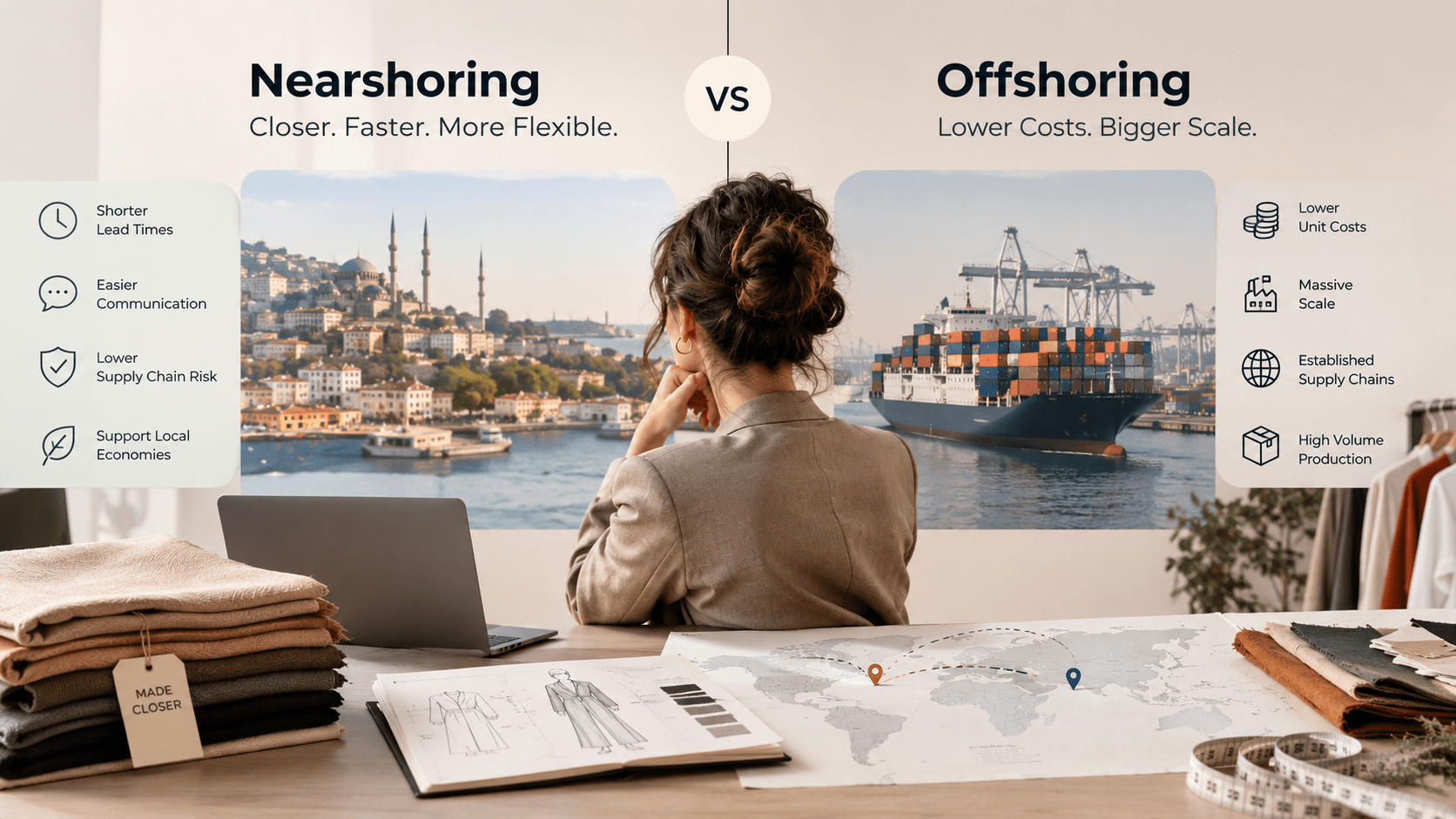
There's a question doing the rounds in pretty much every sourcing meeting right now and it's not going away any time soon. Do you keep shipping production halfway across the world because that's how it's always been done, or do you move it closer to home and deal with the trade-offs that come with that instead?
A few years ago this wasn't really a live debate. Offshore was just the default, full stop. Nobody questioned it much. Then a run of shipping delays, container shortages, and painfully long lead times happened all at once, and suddenly a lot of fashion brands were asking themselves whether the old model still made sense.
Nearshoring stopped being a niche idea for brands with deep pockets and started looking like a genuinely practical option for a much wider range of businesses.
This isn't really about picking a winner, though. Nearshoring vs offshoring in fashion isn't a case of one being obviously better and the other being obviously worse. It's about which one actually fits your brand, your customer, and how fast you need to move.
Here's what the difference actually comes down to, and how to think about it properly.
Nearshoring vs Offshoring in Fashion: What's the Difference?
Offshoring means producing garments in a country that's geographically distant from where the brand sells, usually somewhere with significantly lower labour costs. Think China, Bangladesh, Vietnam, or Cambodia supplying brands based in the UK, US, or Western Europe.
It's been the backbone of apparel manufacturing for decades, and for a lot of very good reasons.
Nearshoring means moving production to a country that's closer, sometimes a neighbouring one, sometimes just a shorter flight or a shorter shipping route away. For UK and European fashion brands, that tends to mean Turkey, Portugal, Morocco, or other parts of Eastern Europe.
It won't always be the cheapest option on paper, but it makes up ground in other places that offshoring simply can't.
Nearshoring and Offshoring at a Glance
- Nearshoring: Neighbouring or nearby region, with lead times typically measured in weeks, usually higher unit costs, smaller runs possible, and easier communication through closer time zones.
- Offshoring: Production on a different continent, with lead times often measured in months, usually lower unit costs, larger production runs, and bigger time-zone gaps.
Neither one is technically right or wrong. They're just built for different priorities, and most brands lean toward whichever one matches what actually matters to them most.
How Nearshoring and Offshoring Compare for Fashion Brands
It's easy to talk about this in the abstract, cost versus speed, quality versus scale, but the real decision comes down to a handful of very concrete factors. Here's how they actually stack up against each other.
- Cost per unit: Nearshoring generally has higher labour costs, while offshoring usually offers lower manufacturing costs.
- Speed to market: Nearshoring can often deliver in weeks, while offshore production can take considerably longer.
- Minimum order quantities: Nearshore suppliers may support smaller runs, whereas offshore factories commonly work around larger production volumes.
- Quality oversight: Nearshore facilities are generally easier for brands to visit, audit, and monitor closely.
- Supply chain risk: Shorter nearshore routes can reduce exposure to some global shipping disruptions.
Cost and Total Landed Cost
Offshore manufacturing usually wins on unit cost, that part hasn't changed. Labour is cheaper, factories operate at massive scale, and per-garment pricing reflects that.
But unit cost isn't the same thing as total landed cost, and that's where a lot of brands get caught out.
Shipping, customs duties, warehousing while stock sits in transit, and the cost of holding extra inventory to cover long lead times all add up. Once you factor all of that in, nearshoring's higher per-unit price starts looking a lot more reasonable, sometimes even competitive, depending on the category and order volume.
Lead Times and Speed to Market
This is where nearshoring genuinely pulls ahead. A shorter shipping route means the gap between placing an order and having stock on shelves shrinks from months down to weeks.
For brands that live and die by trend cycles, or that need to react quickly to what's actually selling rather than what was forecast six months earlier, that speed is difficult to put a price on.
Offshore production, by contrast, usually means committing to stock well in advance, based on a guess about what demand will look like by the time it finally arrives.
Flexibility and Minimum Order Quantities
Offshore factories are typically built around scale. Large production runs, high minimums, efficient at volume but inflexible below a certain threshold.
That works brilliantly for big brands ordering thousands of units per style. It works a lot less well for smaller or mid-sized brands trying to test a new style without committing to a warehouse full of it.
Nearshore manufacturers, especially smaller and mid-sized ones, tend to be more comfortable with lower minimums. That flexibility matters enormously for brands who want to test styles, respond to trends quickly, or simply don't have the order volume to justify offshore minimums in the first place.
Quality Control and Supplier Communication
Distance makes oversight harder, there's no getting around that. Visiting an offshore factory usually means a long-haul flight, a translator, and a trip that has to be planned weeks in advance.
Nearshore facilities are simply easier to visit, audit, and build a real relationship with.
Time zones matter more than people expect too. A same-day email exchange with a nearshore supplier can take days to resolve with a factory twelve hours ahead, and when a production issue needs fixing fast, that gap costs real time and real money.
Supply Chain Risk
The last few years have made this one impossible to ignore. Port congestion, geopolitical tensions, freight cost spikes, and a single blocked shipping lane have shown just how exposed offshore supply chains can be to disruptions that have nothing to do with the brand or the factory itself.
Shorter, simpler nearshore routes aren't immune to disruption either, nothing really is, but they carry noticeably less risk simply because there are fewer links in the chain that can break.
When Does Nearshoring Make More Sense?
Nearshoring tends to make the most sense for brands that need to move fast and stay flexible.
If a brand is chasing trends in near real time, running frequent small drops, or needs the ability to reorder a bestseller within a couple of weeks rather than a couple of months, nearshore production usually serves that better.
It also suits brands building their story around transparency and sustainable fashion sourcing, since shorter supply chains are generally easier to trace, audit, and speak honestly about.
And for anyone leaning into "Made in Europe" or European clothing manufacturers as part of their brand identity, nearshoring is really the only route that delivers on that promise.
When Is Offshoring Still the Better Choice?
Offshoring hasn't gone anywhere, and for a lot of brands, it's still clearly the smarter call.
Basics, high-volume core lines, and anything where price point is the primary competitive lever tend to work better through offshore fashion manufacturing, where scale genuinely drives cost down in a way nearshoring can't fully match.
Brands with long, stable planning cycles, where styles are locked in well ahead of the season and demand is relatively predictable, also don't lose much by accepting a longer lead time.
If speed isn't the constraint, offshore's cost advantage is hard to walk away from.
Why Some Fashion Brands Are Using Both
More and more brands aren't picking a side at all; they're running a hybrid sourcing strategy instead.
Core, predictable, high-volume styles go offshore where the cost advantage is real and lead times don't matter as much. Trend-led pieces, smaller drops, and anything that needs a fast reorder go nearshore, where speed and flexibility actually earn their keep.
It's not the easiest model to manage; running two supply chains at once brings its own coordination headaches, but for brands with the operational bandwidth to handle it, it offers something neither model delivers entirely on its own.
How UK Fashion Brands Should Choose a Sourcing Model
For UK fashion sourcing specifically, the calculation looks a little different than it might for a US brand.
Turkey and Portugal sit within genuinely practical shipping and travel distance, and both have well-established, high-quality apparel manufacturing bases already serving major European labels.
Brands should weigh up their actual reorder frequency, how often they realistically need to top up bestsellers, how important a "Made in Europe" story is to their customer, and how exposed they currently are to global shipping disruption.
Those four questions alone tend to point pretty clearly toward which direction makes more sense.
Nearshoring vs Offshoring: Which Is Right for Your Brand?
There isn't a single right answer here, and anyone promising you one is probably oversimplifying things.
The right fashion sourcing strategy depends on your product, your customer, your growth stage, and how much risk your business can comfortably absorb.
What matters most is making the decision deliberately, rather than sticking with whatever model your brand happened to start with.
Sourcing isn't a decision you make once and forget about. It's worth revisiting as your brand, and the world around it, keeps changing.