Why Fashion Sampling Is Changing: From Physical Samples to Digital Prototypes
Somewhere in a shipping crate right now, there's a physical sample travelling halfway across the world just so someone can look at it, note down two small changes, and send it straight back to be made again. That's how fashion sampling has worked for decades, and honestly, it's a strange amount of time and freight for a garment that might get discarded after a single meeting.
A growing number of brands and manufacturers have started asking a fairly obvious question. Does every single sample really need to be physical? For a lot of the process, it turns out the answer is no, and that's what's driving one of the more genuinely useful shifts happening in fashion product development right now.
Here's what's actually changing, what digital sampling can and can't do yet, and where physical samples still earn their place.
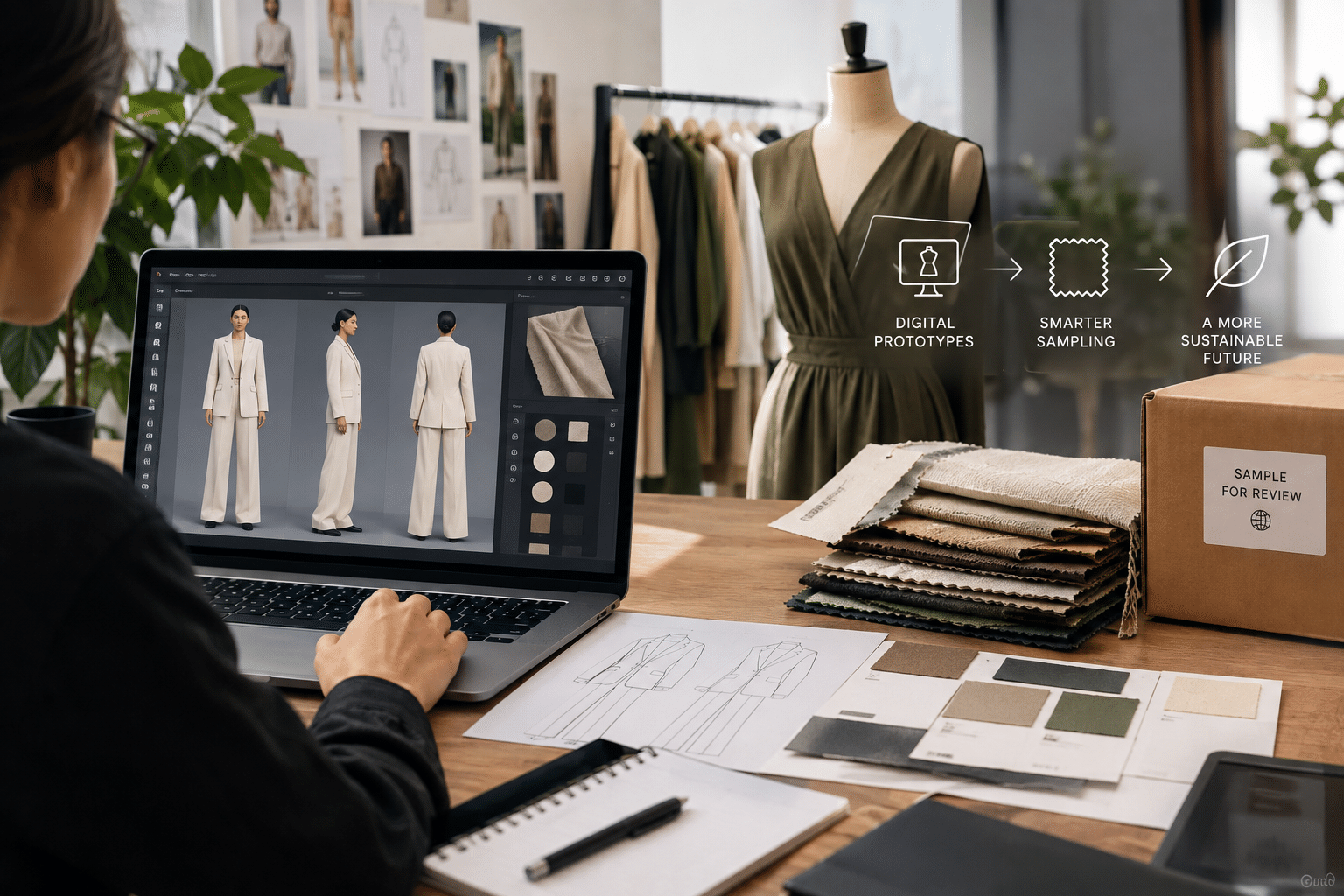
Digital prototypes can move much of the early sampling process onto the screen, reducing unnecessary physical samples while keeping physical testing for the stages where it genuinely matters.
Why Traditional Fashion Sampling Is Being Rethought
The traditional fashion sampling process has always run on physical back-and-forth. A tech pack gets sent, a factory produces a sample, it ships, someone reviews it, feedback goes back, and the whole loop repeats until everyone's happy. Each round easily takes two to three weeks once shipping and review time are added in, and most garments need more than one round to get right.
That process was built for a slower industry, one where a handful of sample rounds a season was manageable. It's a much harder fit for brands now working with shorter timelines, more frequent drops, and considerably less patience for a sample sitting in customs for a week.
There's a cost problem too. Physical samples use real fabric, real labour, and real shipping, all for something that often exists purely to be looked at and then revised. Multiply that across dozens of styles a season, and it adds up to a genuinely significant amount of time and material spent on things that never actually get sold.
What Are Digital Fashion Prototypes?
Digital fashion prototypes are 3D representations of a garment, built using specialised design software rather than fabric and thread. A designer creates a virtual pattern, applies a digital fabric with realistic weight, drape and stretch properties, and essentially builds the garment on screen instead of on a cutting table.
The better tools go well beyond a flat sketch. 3D garment sampling can show how a fabric will actually move on a body, how a seam sits, how a silhouette looks from every angle, and increasingly, how different colourways or fabric options would look without producing a single physical version of any of them.
It's not just a nicer-looking sketch. It's a genuine working prototype that a designer, buyer or manufacturer can review, rotate, and give feedback on, all without anything physical changing hands yet.
Digital Prototypes vs Physical Samples
The comparison isn't really about one replacing the other, it's about what each one is actually good for. Digital prototypes are fast. A change to a seam line or a colourway can happen in minutes rather than requiring an entirely new physical sample and another shipping cycle.
They're also considerably cheaper at this stage, since no fabric or labour is consumed just to test an idea, and they let a brand review far more design variations than would ever be practical to physically produce.
Physical samples still do something digital simply can't. There's no substitute yet for actually touching a fabric, feeling its weight, checking how a garment truly fits a real body, or confirming that stitching holds up the way it's meant to.
Fit, in particular, still needs a physical stage before anything goes to bulk production, since even excellent 3D simulation isn't a perfect stand-in for a body trying the garment on.
The realistic picture is that virtual fashion sampling now handles the early rounds efficiently, and physical samples step in once a design is close to final, for the checks that genuinely need a real, touchable garment.
How Digital Sampling Is Changing the Product Development Process
The biggest shift is speed. Where a brand might previously have gone through three or four physical sample rounds to land on a final design, much of that iteration can now happen digitally first, with only the near-final version actually produced physically.
That alone can meaningfully shorten the overall fashion sampling process.
It's also changing how decisions get made earlier in development. Buyers and merchandising teams can review and approve a design digitally before committing fabric or factory time to it, which means fewer physical samples get made for ideas that were never going to move forward anyway.
Digital garment development is also opening up more genuine experimentation. Testing five colourways or two slightly different silhouettes costs almost nothing extra digitally, compared to the real cost and time of producing that many physical variations just to compare them side by side.
What This Means for Fashion Brands and Manufacturers
For brands, this generally means faster decision-making and lower sampling costs, particularly valuable for smaller labels who've historically found the cost of multiple physical sample rounds genuinely prohibitive.
It also means design teams and buyers, who might be in completely different countries, can review the same digital prototype together in real time rather than waiting for a single physical sample to physically travel between them.
For manufacturers, it shifts part of the workload earlier in the process. Factories increasingly need some familiarity with digital pattern files and 3D specifications, even if their core physical sampling and production work stays largely the same.
Manufacturers who've adopted digital fashion sampling tools are generally able to move from an approved digital prototype into a physical sample faster, since a lot of the fit and design uncertainty has already been resolved before fabric is even cut.
Is Digital Sampling Really Replacing Physical Samples?
Not entirely, and probably not any time soon. What's actually happening is more of a division of labour between the two.
Digital prototypes now handle a lot of the early exploration, design iteration, colourway testing, and silhouette approval, while physical samples are reserved for the stages that genuinely need something real, fit confirmation, fabric hand-feel, and final pre-production sign-off.
Brands still relying entirely on physical sampling from the very first round are, more often than not, spending unnecessary time and money on rounds that a digital prototype could have handled just as well, and considerably faster.
What the Future of Fashion Sampling Could Look Like
The direction of travel points toward digital tools becoming standard at the front end of development, with physical sampling reserved for fewer, more purposeful rounds rather than the default from day one.
As fabric simulation technology keeps improving, the gap between how a digital prototype looks and how the real fabric behaves is likely to keep narrowing too.
There's also a sustainability angle that's hard to ignore. Fewer unnecessary physical samples means less fabric waste, less shipping, and a meaningfully lighter footprint across the development process, a genuine side benefit rather than the main reason brands are adopting this, but a welcome one regardless.
Physical samples aren't disappearing, and for the foreseeable future they shouldn't. But the sampling process as a whole is clearly becoming faster, cheaper, and considerably less wasteful than it used to be, and that shift is only likely to keep accelerating.