Why Japanese Denim Still Dominates the Premium Market
Ask anyone who's genuinely into denim where the best fabric comes from, and you'll get the same answer almost every time. Not Italy, not the US, not wherever it's cheapest that year. Japan. Specifically, a fairly unglamorous cluster of towns in Okayama Prefecture that most people outside the industry have never heard of.
It's a strange thing when you think about it. Denim was invented in America. Levi's basically built the whole category. And yet somewhere along the way, Japan quietly became the place the rest of the world's best brands go to buy their fabric. Louis Vuitton sources denim from there. So does Gucci. So do a long list of premium labels that could theoretically get cloth from anywhere on earth.
So what's actually going on here? Why does a handful of mills in a corner of Japan still set the standard everyone else is measured against, decades after the trend cycle should have moved on? Let's get into it.
Japanese denim still leads the premium market because it's built on patience, not speed, old machines running slower than modern ones by design, and craftsmanship that simply can't be rushed onto a faster production line.
What Makes Japanese Denim Different?
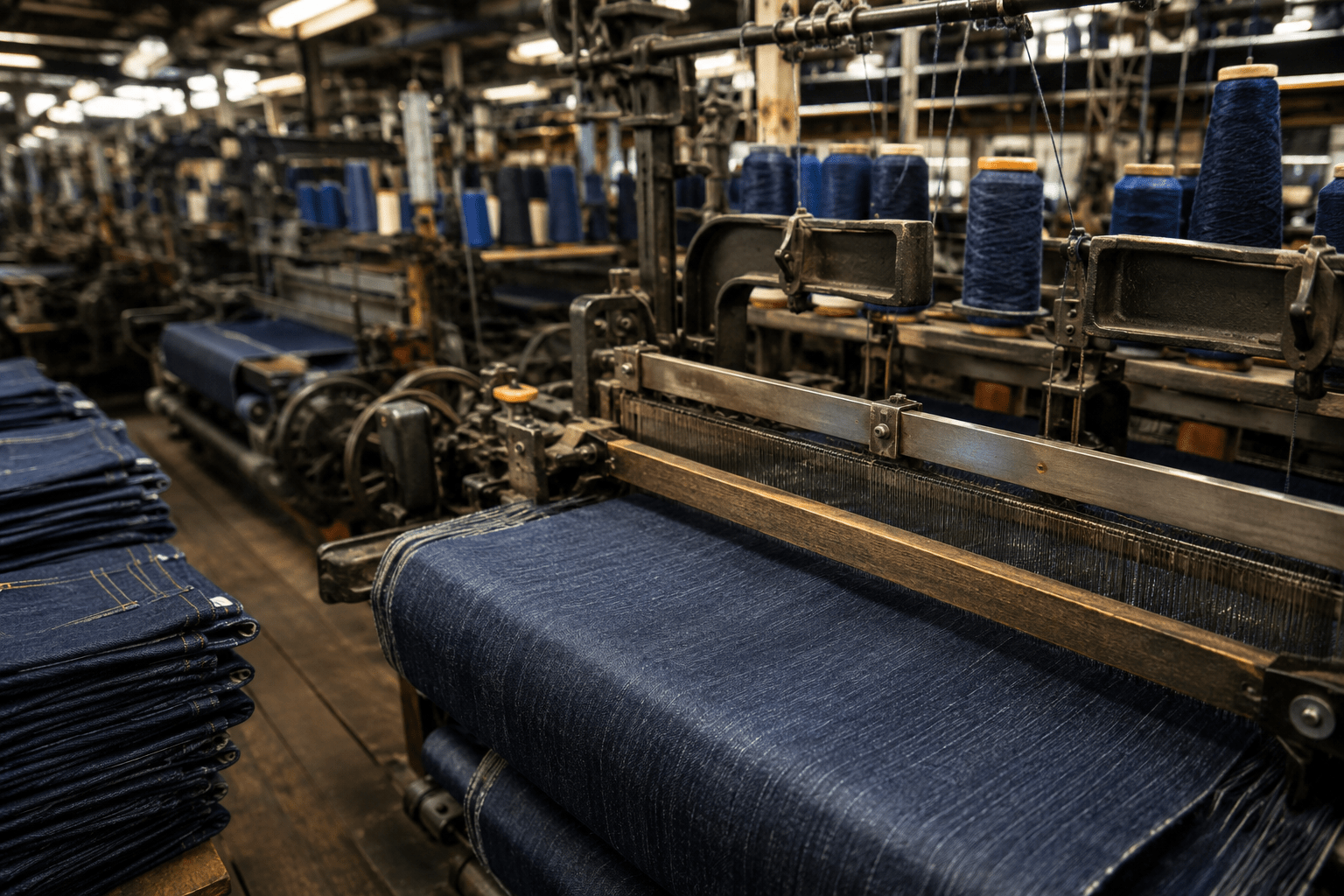
The short version: almost everything about how it's made runs against the logic of modern manufacturing. Most denim today comes off high-speed projectile looms, wide, efficient, churning out hundreds of metres an hour. Japanese denim, or at least the good stuff, is still woven on vintage shuttle looms that manage something closer to five metres an hour.
That's not a typo. Five. That slowness isn't a limitation the mills are stuck with, it's the actual point. The gentler, lower-tension weave creates a slightly uneven, textured surface, little irregularities called slub, that gives the fabric character right from the start and lets it fade in far more interesting ways over time.
Combine that with narrow-width fabric that produces a genuine self-finished selvedge edge, and you get cloth that simply behaves differently to anything coming off a modern high-speed loom. This is really what makes japanese denim different from everything else on the market, not marketing, just physics and patience.
The Craftsmanship Behind Japanese Denim
There's a reason people talk about Japanese mills the way wine collectors talk about specific vineyards. It's not just tradition for tradition's sake, every part of the process is genuinely deliberate.
Traditional Shuttle Looms and Selvedge Denim
Many of the machines still running in Okayama today are Toyoda G3 looms, some of them originally built between the 1920s and the 1960s. Japanese mills bought up surplus shuttle looms from American and European manufacturers decades ago, when everyone else was switching to faster projectile machines, and instead of scrapping them, they restored them and kept them running.
The payoff is selvedge denim, fabric with a clean, self-contained edge that won't fray, produced almost as a side effect of how the shuttle loom moves back and forth across a narrow width. It's slower, it's less efficient, and it's exactly why japanese selvedge denim still commands the kind of respect it does among people who actually know fabric.
Indigo Dyeing and Fabric Development
Then there's the dyeing. Traditional rope dyeing involves repeatedly dipping bundles of yarn into indigo vats, sometimes eight to twenty times, letting each layer oxidise in the air before the next dip. The result is a yarn that's saturated with indigo on the surface but stays white right at the core.
That white core is the whole secret behind how these jeans fade. As the surface indigo wears away through friction and washing, the white underneath starts showing through, creating those sharp, high-contrast whiskers and honeycomb creases that raw denim fans genuinely obsess over.
Mills also experimented constantly, playing with unusual cotton blends, natural dyes like persimmon tannin, and heavier weights that push well past what most denim ever attempts.
Attention to Detail and Quality Control
None of this stops once the fabric leaves the loom. Japanese denim manufacturing tends to carry the same obsessive standards through cutting, stitching and finishing, matching selvedge lines precisely, reinforcing stress points, checking construction by hand rather than assuming a machine got it right.
Some brands even back that confidence up with genuinely long repair warranties on their stitching, which says a lot about how seriously quality control is taken from start to finish.
Japanese denim commands a premium because its character comes from slower looms, specialised craftsmanship, careful dyeing and quality control that cannot simply be replicated through faster mass production.
```Why Japanese Denim Commands a Premium Price
None of what's described above is cheap or fast, and that's really the whole explanation for the price tag. A shuttle loom running at five metres an hour costs the same in labour and factory time whether it's producing five metres or five hundred, so the output per hour is dramatically more expensive than fabric off a modern loom running at full speed.
Add in premium long-staple cotton, often sourced from Zimbabwe or the US specifically for its length and strength, plus the extra time rope dyeing takes compared to quicker dyeing methods, and the cost stacks up fast before a single seam is even sewn.
This is really the honest answer to why is japanese denim expensive, it isn't a luxury markup dreamed up by a marketing team, it's the actual cost of refusing to speed up a process that depends on being slow.
The Role of Okayama and Kojima in Japanese Denim
If Japanese denim has a home address, it's Kojima, a district of Kurashiki City in Okayama Prefecture. Denim actually arrived here almost by accident, Kojima had spent years making school uniforms and military wear, and when American jeans started showing up on the backs of US servicemen after the war, local manufacturers eventually pivoted the same skills toward producing them.
What makes the region genuinely special today is density. Spinners, dyers, weavers and finishers are all clustered within a fairly small area, which means fabric can move between highly specialised experts at each stage rather than one factory trying to do everything adequately.
That concentration of expertise is a big part of why japanese denim mills in this one small region can outproduce, in quality if not volume, denim makers scattered across much larger countries.
Why Premium Brands Continue to Choose Japanese Denim
For luxury and premium labels, sourcing from Japan isn't really about chasing a trend, it's about buying into a level of craftsmanship customers can actually feel the difference in.
A pair of raw Japanese jeans doesn't look like much on the rail, stiff, dark, unwashed. Worn in over a year, though, it becomes something genuinely personal, fades shaped by exactly how someone sits, walks, carries their phone.
That's a hard story to tell with mass-produced denim, and it's exactly the kind of story premium brands want attached to their name.
Combine that with mills that keep investing in fabric research rather than resting on heritage alone, and it's easy to see why so many international labels keep coming back to the same handful of japanese denim suppliers season after season, rather than chasing whatever's cheapest that year.
Can Japanese Denim Maintain Its Premium Position?
This is the honest question worth asking. Skilled loom operators are getting older, and running a decades-old Toyoda machine isn't exactly a skill you pick up from a manual, it takes years of hands-on experience most younger workers aren't lining up for.
Rising costs and global competition from other premium denim manufacturing hubs add real pressure too. That said, the mills haven't been standing still.
They're pairing old machinery with genuine material innovation, new cotton blends, experimental dyeing, heavier weights, rather than just selling nostalgia.
As long as premium brands keep valuing character and durability over speed and volume, and as long as customers keep caring about jeans that age like something worth keeping, Japanese denim looks well placed to hold its position.
It's earned it the hard way, one slow metre at a time.